

Solar panels in winter: what homeowners in Devon and Cornwall need to know
If you’ve recently had solar panels installed, or you’re thinking about getting them, it’s natural to wonder what happens when summer ends and the seasons change.
The days get shorter, the weather becomes more unpredictable and you’ll probably start using more electricity at home as heating, lighting and appliances become a bigger part of your daily routine.
How well do solar panels perform in winter?
The answer is better than you might think, but generation is lower than during the longer, brighter days of spring and summer.
Solar panels don’t stop working when temperatures fall or clouds appear. They continue generating electricity whenever there is daylight, and there are several things you can do to make the most of the energy your system produces.
Here’s what homeowners across Cornwall and Devon need to know.
Do solar panels work in winter?
Yes. But there are things to consider.
Solar panels generate power from daylight, rather than high temperatures or direct sunlight. That means your panels absolutely continue working in autumn and winter.
The caveat is that your system will generally generate less in winter than it does in summer. That’s for two main reasons:
- There are fewer hours of daylight.
- The sun is lower in the sky, meaning the amount and intensity of light reaching your panels is generally lower.
Cloud cover can reduce generation further, but panels don’t stop producing electricity – they just produce less.
If we’re honest, we all know that cloudy days in Cornwall and Devon aren’t restricted to winter! But the main point is that seasonal variation is normal and should be factored into any realistic assessment of a solar PV system.
Year-round benefits of solar
It might seem strange to think about solar when the days are getting shorter, but your annual energy use doesn’t follow the same pattern as your solar generation.
Your household may use more electricity in winter on everyday things like heating your home; keeping the lights on; using more appliances because you spend more time indoors; charging an electric vehicle
It’s important to consider this when weighing up the benefits of solar, and there’s an important distinction between summer and winter performance.
Summer is genneraly when solar panels generate the most electricity. Winter is often when your home needs more energy.
In reality, a well-designed domestic solar system doesn’t produce all the electricity you need at every moment of the year. But it will generate useful renewable electricity year-round, reducing the amount of energy you need to buy from the grid.
Do that successfully over years, and you understand why the up-front investment can be justified.
How much electricity do solar panels generate in winter?
Well, there’s no single answer. Every home, business and installation is different, individually assessed based on the location, roof space, and other factors. These factors include:
- The size of your solar PV system
- Roof orientation
- Roof pitch
- Shading
- Location
- Weather
- Panel technology
- The condition and performance of your system
What we can say with confidence is that you should expect your solar system to keep generating electricity through the winter, although it will produce less than in summer’s longer days and (generally) better weather.
That’s why you shouldn’t assess solar performance based on a single month. We would expect any system to generate more in June or July than it does in December or January. Our installers can help you understand that and what to expect, and we can predict estimated generation at different times and explin how that compares to how your household uses electricity.
The most important thing to remember is that over a year, a well-designed solar system will reduce the amount of power you need to buy from the National Grid.
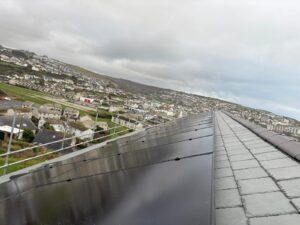
Solar panels generate electricity with diffused light and still work on cloudy days.
Do cloudy days and cold weather impact solar generation?
One of the biggest misconceptions about modern solar panels is that they don’t work on cloudy days. The reality is they don’t need bright sunshine to work. Your panels will still produce power from diffuse light on cloudy days, but generation will be lower than under clear skies.
Modern solar tech is designed to operate in different conditions, including cloudy days in Cornwall and Devon. That’s why it is so widely used across the UK.
Interestingly, solar panels don’t dislike cold weather, so temperature isn’t a major concern. The bigger winter issue is the reduced sunlight and shorter daylight hours.
Heavy snow can temporarily prevent generation, but this is less of a concern for most properties in Cornwall and Devon than it is in colder parts of the UK.
Rain and sleet can even help keep panels clean by washing away dust and other surface debris.
Remember, the most important thing is annual generation, so you don’t need to worry that a cloudy winter day means your panels generate less.
Want to read more about solar – visit our post about checking how solar-ready your house is.
Solar panels in winter, FAQs
Will solar panels work during winter?
Yes. Solar panels continue to generate electricity whenever there is daylight but generation is generally lower during winter because there are fewer daylight hours and the sun is lower in the sky.
Do solar panels work on cloudy days?
Yes. Solar panels can generate electricity from diffuse daylight. Output will normally be lower than on a bright, sunny day.
Should I get a battery with my solar panels?
It depends on your energy use, when you use electricity, your solar system and your wider energy plans. A battery can store surplus solar electricity for use later.
Can I charge my electric car using solar panels in winter?
Solar generation can charge an EV, but the amount of solar electricity available varies throughout the year. In winter, you may need to use electricity from the grid alongside solar-generated electricity.
Do solar panels need cleaning before winter?
Solar panels generally require little maintenance, and rainfall can help keep them clean. However, if you notice a significant change in performance, consider contacting your installer rather than accessing the roof yourself.
Will solar panels reduce my electricity bills in winter?
They can. Your panels will still generate electricity, reducing how much you need to buy from the grid. The savings will depend on your system, household consumption, generation and tariff.
Is winter a bad time to install solar panels?
Not necessarily. Panels can be installed at any time, subject to weather. If you install in winter, it means you start generating electricity straight away rather than waiting until spring.