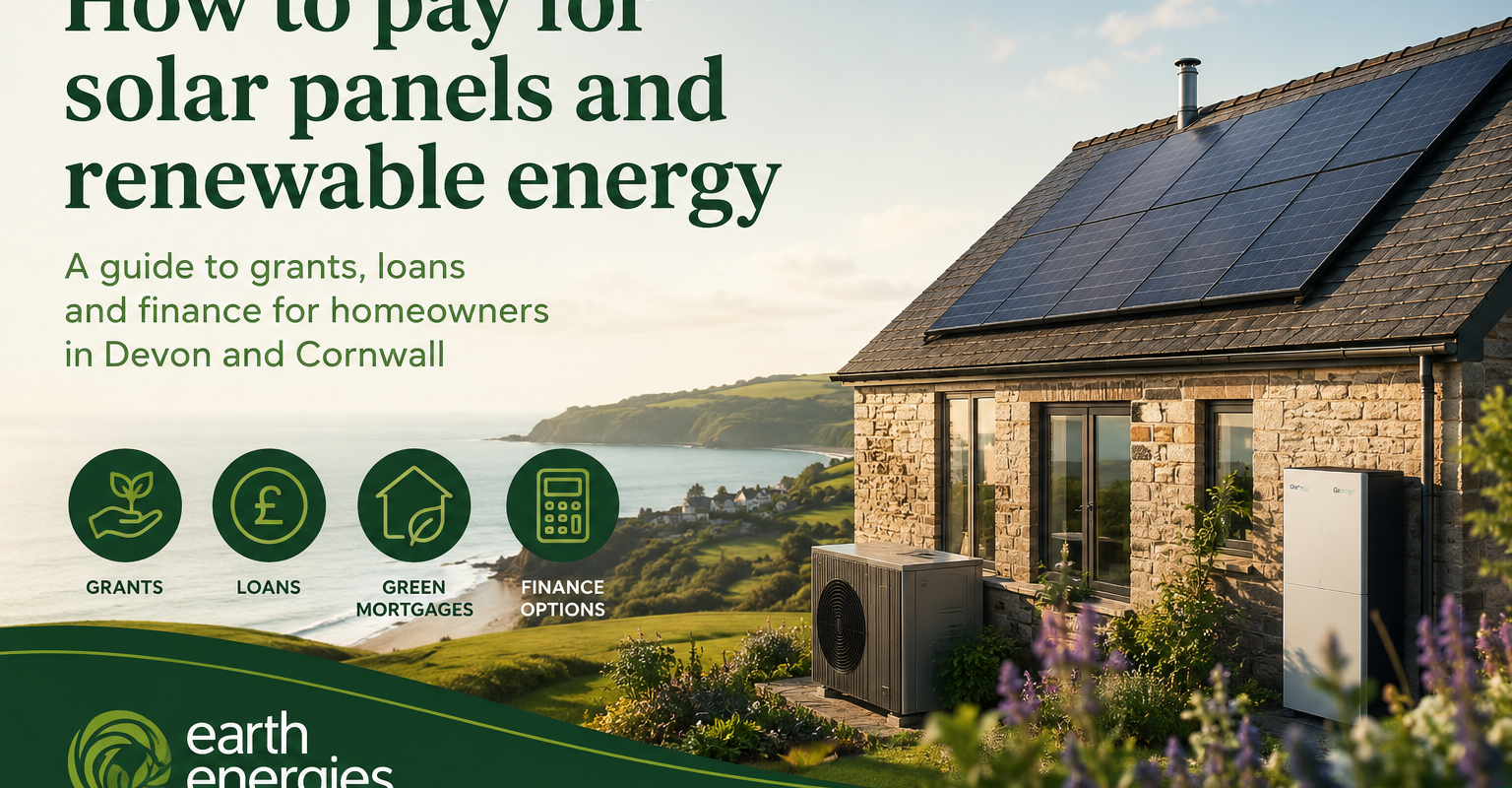
Installing solar panels, battery storage, a heat pump or another renewable energy system is one of the best long-term investments many homeowners can make. But while the benefits are clear – lower energy bills, greater energy independence and reduced carbon emissions – the upfront cost can feel like a barrier.
The good news is that paying for renewable energy has changed significantly. While generous nationwide grants are less common than they once were, homeowners in Devon, Cornwall and across South West England now have access to a wider range of funding options. Depending on your circumstances, that could include government-backed grants, low-interest loans, green mortgages, council-backed schemes and finance designed specifically for home energy improvements.
At Earth Energies, we’ve worked with homeowners and businesses across Devon and Cornwall to design renewable energy systems that suit different properties, lifestyles and budgets. Every property is different, so understanding the financial options available is often the first step towards making renewable energy more affordable.
In this guide, we’ll explain the main ways to pay for solar panels and renewable energy systems, helping you understand which options might be right for you.
Why Devon and Cornwall are well placed for renewable energy
Homeowners in Devon and Cornwall are in a particularly strong position to benefit from renewable energy.
The South West enjoys some of the highest sunshine hours in England, making solar PV an excellent long-term investment. At the same time, councils in both Cornwall and Devon continue to support energy efficiency and carbon reduction through local initiatives and partnerships. So, how should households make the most of a growing range of funding opportunities?
For many households, the most affordable solution isn’t relying on a single funding source. Instead, it may involve combining several forms of support, including:
- Government grants (where eligible)
- Low-interest loans or installer finance
- Green mortgages
- Council-backed energy efficiency schemes
- Smart Export Guarantee payments
- 0% VAT on eligible renewable energy installations
Can you get a grant for solar panels?
The short answer is yes, but not everyone will qualify.
Many people still search online for “solar panel grants”, but it’s important to understand that universal grants for domestic solar installations are largely a thing of the past. Today’s funding is generally targeted towards improving the energy efficiency of homes occupied by lower-income households or those living in less energy-efficient properties.
If you’re eligible, however, grants can make a significant difference to the overall cost of installing renewable technologies.
Warm Homes Scheme
The Warm Homes Scheme is one of the Government’s main programmes for improving the energy efficiency of homes.
Rather than funding solar panels alone, the scheme takes a whole-house approach. Depending on your property’s needs, support may be available for measures including:
- Solar panels
- Battery storage
- Insulation
- Heat pumps
- Ventilation improvements
The aim is to reduce household energy bills while improving comfort and lowering carbon emissions.
Many elements of the scheme are delivered through local authorities, meaning eligibility and available funding can vary between different parts of Devon, Cornwall and neighbouring counties. You’ll need to check what is available where you live.
Does your EPC rating matter?
Yes. Many funding schemes consider the Energy Performance Certificate (EPC) rating of your property.
Homes with lower EPC ratings often have the greatest potential for energy improvements and may therefore be more likely to qualify for support. However, your EPC rating is only one factor. Household income, property type and local funding availability are also taken into account.
Who is most likely to qualify?
You may be eligible for grant funding if you:
- Receive certain income-related benefits or have a lower household income.
- Own or privately rent a home with a lower EPC rating.
- Live in a property that is expensive to heat.
- Live in an area where your local authority is delivering a funded energy efficiency programme.
If you’re unsure whether you qualify, it’s worth speaking to your local authority, which should have people who can point you in the right direction.
Is solar worth it if you don’t qualify for a grant?
Absolutely. One of the biggest misconceptions is that renewable energy only makes financial sense if you receive grant funding.
In reality, many homeowners choose to install solar panels because the long-term savings can outweigh the upfront investment. Modern solar panels are more efficient than ever, battery storage allows more of your generated electricity to be used at home, and eligible systems can earn income through the Smart Export Guarantee by selling excess electricity back to the grid.
Combined with today’s financing options and the continued 0% VAT rate on many domestic renewable energy installations, solar has become more affordable than many people realise.
How to access renewable energy loans and finance
As direct grant funding has become more targeted, low-interest finance has become an increasingly popular way to fund renewable energy installations.
Depending on the finance products available and your circumstances, borrowing can help spread the cost of installing:
- Solar panels
- Battery storage
- Heat pumps
- Insulation
- EV charging points
The idea is simple: instead of paying the full cost upfront, homeowners spread the investment over time while benefiting from lower energy bills from day one.
Before taking out any loan, it’s important to consider your personal financial circumstances and seek independent financial advice where appropriate.
Council-backed finance and local schemes
Alongside national initiatives, some local authorities work with finance providers to help homeowners improve the energy efficiency of their homes.
In parts of the South West, council-backed finance schemes may be available to help fund renewable energy improvements and wider home energy upgrades.
As these schemes vary by location and funding availability, it’s always worth checking what’s currently available in your local area.
Can ‘green mortgages’ help pay for renewable energy?
Increasingly, yes. Many mortgage lenders now recognise that energy-efficient homes cost less to run and are becoming more desirable. As a result, some offer products designed to encourage homeowners to improve the energy performance of their property.
Green mortgages
Depending on the lender, green mortgages may include:
- Additional borrowing for renewable energy improvements
- Preferential interest rates
- Cashback incentives
- Products designed specifically for energy-efficient homes
If you’re already planning to remortgage or move home, it’s worth asking your lender whether they offer a green mortgage or home energy improvement product.
Green home improvement loans
Banks, building societies and specialist lenders may also offer loans specifically designed for home improvements, including renewable energy installations.
For some homeowners, these can provide a flexible way to spread the cost of investing in solar panels, battery storage or heat pumps. As with any borrowing, it’s important to understand the terms of the loan and consider whether repayments fit comfortably within your household budget.
Don’t forget the VAT savings
One of the biggest financial incentives available today isn’t actually a grant.
Many domestic renewable energy installations, including solar panels, battery storage and heat pumps, currently benefit from a 0% VAT rate.
Although it doesn’t eliminate the upfront cost, it significantly reduces the overall price of installing renewable energy and should be factored into any cost comparison.
Which funding option is right for you?
While Earth Energies doesn’t provide financial advice, the table below offers a simple guide to the options that may suit different circumstances.
Your situation | Funding option to explore |
| Lower household income | Warm Homes Scheme or local authority support |
| Planning to remortgage | Green mortgage products |
| Staying in your home long-term | Home improvement loans or installer finance |
| Business owner | Commercial renewable energy finance |
| Installing a heat pump | Boiler Upgrade Scheme (where eligible) |
Frequently asked questions
Can I get free solar panels?
It’s unlikely; free solar panel schemes are now very limited. However, eligible households may qualify for support through government or local authority programmes designed to improve home energy efficiency.
Can I combine grants and finance?
In some cases, yes. Depending on your circumstances, homeowners may be able to combine grant funding with other finance options to reduce upfront costs.
Are solar panels worth it in Devon and Cornwall?
Generally, yes. Devon and Cornwall receive some of the highest sunshine levels in England, making solar panels an attractive long-term investment for many properties. We can give you further advice on what options suit your circumstances.
Can battery storage be financed?
Yes. Battery storage can often be included within renewable energy finance packages or installed alongside solar panels as part of a wider project.
Speak to Earth Energies
Get in touch today and take the first step towards renewable energy solutions.
Every property is different, and so is every homeowner’s energy use, budget and long-term plan.
Whether you’re exploring grants, comparing finance options or simply trying to understand what’s possible, the Earth Energies team can help you make sense of the choices available. We’ll explain the technologies that suit your home, discuss the funding routes that may be relevant, and provide straightforward advice to help you make an informed decision.
If you’re considering solar panels, battery storage, heat pumps or another renewable energy solution in Devon, Cornwall or the wider South West, we’d be delighted to help you take the next step.